Home → CRM for Small Business Australia
Best CRM Programs for Small Businesses in Australia (2026)
CRM software for small business, compared for the Australian market
Choosing a CRM as a small business in Australia means wading through global brands built for enterprise sales teams, directory sites that list 200 options without picking one, and pricing pages quoted in US dollars before tax. This guide cuts through it: the CRM programs Australian small businesses actually use in 2026, what they cost in AUD, where each one fits, and how to choose.
Every option below is judged on the things that matter to a small Australian services business: real monthly cost including GST, whether support sits in your timezone, how much of your tool stack it replaces, and how quickly your team can actually run it.
Short on time? If you want one platform that replaces your CRM and your marketing tools with Australian-based onboarding included, see how Clientflow compares to seven major CRMs →
What “CRM software for small business” actually needs to do
A small business CRM is software that stores your contacts, tracks every deal through your sales pipeline, and automates the follow-up that would otherwise slip through the cracks. For a small Australian business specifically, the right CRM should:
Centralise every contact and conversation - email, SMS, calls and bookings against one record, not scattered across tools.
Show your pipeline at a glance - where every lead sits, what’s next, and what’s gone cold.
Automate follow-up - so a lead that fills in a form on Tuesday isn’t waiting until Friday for a reply.
Price honestly in AUD - including GST, without per-user charges that punish you for growing.
Support you locally - in your timezone, by people who understand Australian business.
Replace tools rather than add to them - the last thing a small team needs is a tenth login.
Most CRMs do the first three. Far fewer do the last three. That’s the gap this guide focuses on.
The best CRM programs for small businesses in Australia
1. Clientflow - best all-in-one CRM for Australian services businesses
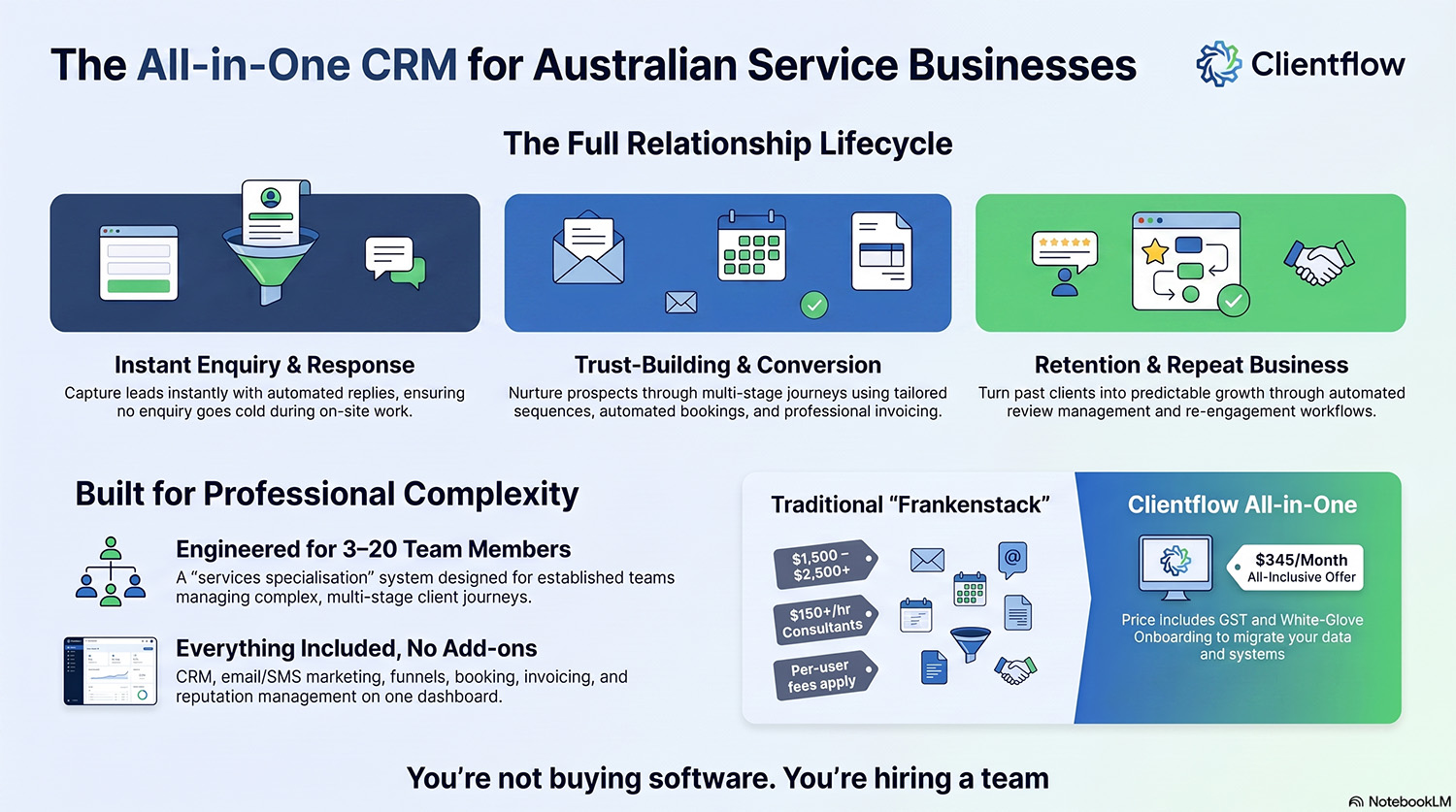
Clientflow combines CRM and pipeline management with email, SMS, funnels, booking, invoicing, automation and AI in a single platform for $345/month inc GST - with unlimited users and contacts, no annual lock-in, and white-glove onboarding by an Australian-based team. It’s built for established services businesses (3-20 people, $500K+ revenue) that have outgrown a spreadsheet but don’t want to stitch ten tools together.
What sets it apart from every other CRM on this list is what happens after setup. Clientflow’s Australian expert implementation team will build bespoke, end-to-end automation tailored to your exact business at $25/hour - a rate that changes the economics of customisation entirely (more on why that matters below).
Best for: Australian services businesses that want their CRM and marketing on one dashboard, plus the ability to have complex, custom automation built for them affordably.
Pricing: $345/month inc GST, unlimited users and contacts. Expert implementation at $25/hour.
Why it stands out: replaces a $1,500-$2,500/month tool stack; Australian onboarding and support included; no per-user pricing; bespoke automation built for you at a fraction of the usual cost.
2. HubSpot - best free tier to start with
HubSpot offers a genuinely useful free CRM and a polished interface, which makes it a common first CRM. The catch for small businesses is that costs escalate quickly once you need paid features, contacts grow, or you add seats - and onboarding fees apply on higher tiers.
Best for: very early-stage businesses testing CRM for the first time on the free tier.
Watch for: steep price jumps and an annual commitment as you scale. See Clientflow vs HubSpot →
3. Zoho CRM - best for deep customisation on a budget
Zoho CRM is highly customisable and affordable, with standard plans starting around AUD$12-$20 per user/month and a built-in AI assistant (Zia). It’s a strong pick if you want to configure fields and workflows yourself and don’t mind a slightly dated interface - though email, booking and phone are separate Zoho products that add up.
Best for: hands-on owners who want to customise everything themselves.
Watch for: the full Zoho stack costs more than the CRM headline price. See Clientflow vs Zoho →
4. Pipedrive - best simple sales pipeline
Pipedrive is a visual, drag-and-drop sales CRM that small sales teams find easy to adopt. It does pipeline management well and little else - there’s no built-in marketing automation, booking or review management, so you’ll bolt on other tools as you grow.
Best for: small sales teams that only need pipeline tracking.
Watch for: limited beyond sales; you’ll add tools (and integrations) over time.
5. Tall Emu CRM - best established Australian-made option
Tall Emu is an Australian-built CRM with strong inventory and accounting integration, popular with product and wholesale businesses. It’s a credible local option, though its strengths sit more in operations and stock than in marketing automation.
Best for: Australian product/wholesale businesses needing inventory + CRM.
Watch for: lighter on marketing automation than an all-in-one platform. See Clientflow vs Tall Emu →
6. Bigin by Zoho - best for solopreneurs leaving spreadsheets
Bigin is Zoho’s stripped-back, pipeline-first CRM aimed at micro-businesses and solopreneurs, starting around AUD $7-10 per user/month with a free tier. It’s deliberately minimal - perfect for one person who has outgrown Excel, less so for a growing team.
Best for: solopreneurs and micro-businesses wanting the simplest possible start.
Watch for: you’ll outgrow it as the team and processes expand.
Quick comparison
| CRM | Best for | From (AUD) | All-in-one? | AU-based support |
|---|---|---|---|---|
| Clientflow | AU services businesses | $345/mo inc GST, unlimited users | Yes - CRM + marketing | Yes |
| HubSpot | Free-tier starters | Free; paid scales fast | Partial | No |
| Zoho CRM | DIY customisation | ~$12-20/user/mo | Add-ons needed | No |
| Pipedrive | Simple pipelines | ~$20-30/user/mo | No | No |
| Tall Emu | AU product/wholesale | Quote-based | Partial | Yes |
| Bigin by Zoho | Solopreneurs | ~$7-10/user/mo | No | No |
Pricing indicative and changes - check each vendor for current AUD pricing. Clientflow pricing inc GST as at 2026.
How to choose the right CRM for your small business
Count your real tool stack first. List every tool you pay for - email, booking, funnels, invoicing, SMS. If a CRM only replaces one of them, your total cost barely moves. An all-in-one platform changes the maths.
Check the price in AUD, including GST and per-user charges. A “US$12/user” CRM is AUD$1,218/year for a team of five before add-ons. Flat, unlimited-user pricing is far more predictable as you grow.
Confirm support is in your timezone. When something breaks mid-campaign, a local team that knows your account is worth more than a cheaper seat with offshore tickets.
Match the CRM to your client journey, not the other way around. If your business has consultations, inspections, document handling and handoffs, generic templates won’t cut it - you need automation that maps to your actual process.
Weigh setup and customisation, not just subscription. A cheap CRM you never finish configuring costs more than a guided setup that’s live in a fortnight. And ask what it costs to have the system built around your processes - most vendors’ $150-$300/hour implementation rates put real customisation out of reach for a small business, so you end up adapting your business to generic templates instead.
Where Clientflow fits
Most CRMs on this list do one job well and leave the rest to other tools. Clientflow was built for the Australian small-to-mid services business that wants its CRM, marketing automation, booking, invoicing and reporting on one platform - with the migration and setup handled by an Australian-based team, and pricing that doesn’t punish you for adding staff.
If that’s the shape of your business, the fastest way to see whether it fits is a demo.
Clientflow is built on HighLevel. If that name is new to you, what GoHighLevel is explains the platform, how it is normally sold and what that means for a small business buying it.
Book a free demo → | Compare Clientflow against 7 major CRMs →
The hidden advantage: bespoke automation most small businesses can’t normally afford
Here’s the part that rarely makes it into a CRM comparison, because only one option on this list offers it.
Every small business has processes that make it different - the way you qualify a lead, the sequence you take a client through, the follow-up that wins the deal, the intellectual property and competitive edge baked into how you actually work. Off-the-shelf CRM templates can’t capture that. To get a system built around your business, you need someone to build it.
For most CRM vendors, that’s where the door closes for small businesses. Implementation consultants and automation specialists in Australia typically charge $150 to $300 per hour. A genuinely custom, end-to-end automation build runs into dozens of hours, so the bespoke system that would actually move the needle becomes a five-figure project - cost-prohibitive for most SMBs. So they settle for generic templates, leave their real advantages un-automated, and never get the system their business deserves.
Clientflow’s expert implementation team builds exactly that kind of bespoke, end-to-end automation at $25 per hour - the same team that works on the platform all day, every day. The rate isn't a discount on quality; it's deliberate. Clientflow's view is that every business deserves automation built around its own processes, not just the enterprises that can absorb five-figure consulting fees, and that the cost of expert help should never be what stops a client from getting the full return on their subscription. A specialist team working on this one platform daily is efficient enough to make that rate sustainable - so you get more capability, not less. At a fraction of standard consulting rates, custom work that would be unthinkable elsewhere becomes affordable:
A multi-stage pipeline mapped to your exact client journey, not a generic template.
Automation that encodes your competitive advantage - the follow-up, qualification and nurture logic that makes your business win - so it runs every time, automatically.
Custom dashboards, integrations and development wired to how you actually operate.
The result is a CRM that fits your business like a tailored suit, for roughly what most vendors charge for an hour or two of generic setup. For a small business, that’s the difference between adapting yourself to the software and having the software built around you.
Learn more about the expert implementation team → | Book a free demo →
Frequently Asked Questions
What is the best CRM for a small business in Australia?
It depends on what you need the CRM to do. For a single salesperson tracking deals, a simple pipeline tool like Pipedrive or Bigin works. For an Australian services business that wants its CRM and marketing on one platform with local support, Clientflow is purpose-built for that, replacing a stack of separate tools for $345/month inc GST.
How much does CRM software cost for a small business in Australia?
Entry CRMs start around $7-20 per user per month, but per-user pricing adds up fast for a team, and most CRMs only cover part of your tool stack. All-in-one platforms like Clientflow use flat pricing ($345/month inc GST, unlimited users) that replaces multiple subscriptions, so the total software bill usually falls rather than rises.
Is there a free CRM for small businesses?
Yes - HubSpot, Zoho and Bigin all offer free tiers that work for very small contact lists. They’re a good way to start, but free tiers cap contacts, users and features, and costs climb once you outgrow them, so factor in where you’ll be in 12 months.
Do I need an Australian CRM specifically?
Not strictly, but it helps. An Australian-based CRM or provider means support in your timezone, AUD pricing including GST, local SMS compliance, and a team that understands Australian business. Several global CRMs work fine in Australia, but you trade away local support and timezone-aligned help.
What’s the difference between a CRM and an all-in-one marketing platform?
A CRM manages contacts and your sales pipeline. An all-in-one platform adds the marketing tools around it - email, SMS, funnels, booking, automation - on the same database, so a lead captured on a landing page flows straight into your pipeline and follow-up without separate tools or integrations. See what all-in-one actually means →
Can I get a CRM customised to my specific business processes?
Usually it’s cost-prohibitive for a small business - Australian implementation consultants charge $150-$300 per hour, so a custom end-to-end automation build runs into five figures. Clientflow is the exception: its Australian expert implementation team builds bespoke automation tailored to your exact processes at $25/hour, which puts a fully custom system within reach of a small business budget. Learn more about expert implementation →
Ready to See How It Works For Yourself?
Book a free, no-obligation demo to see what Clientflow can do, or Contact Us directly.
Social


© Copyright 2026, Clientflow. All rights reserved.